
The Koh-i-Noor: How Punjab Became Home to the World's Most Famous Diamond
The Koh-i-Noor, meaning "Mountain of Light," is one of the world's most famous diamonds, with a history that spans several empires. Although many legends surround its origins, historians suggest that much of its early history is based on folklore rather than confirmed evidence. The diamond passed through the Mughal, Persian and Afghan rulers before arriving in Punjab in 1813, when Maharaja Ranjit Singh acquired it from the exiled Afghan ruler Shah Shuja after weeks of negotiations. Under the Sikh Empire, the Koh-i-Noor became a powerful symbol of sovereignty and prestige. Following the annexation of Punjab in 1849, it was surrendered to the British under the Treaty of Lahore and eventually became part of the British Crown Jewels. Today, the Koh-i-Noor remains one of the world's most debated cultural treasures, symbolising both imperial history and ongoing discussions about heritage and ownership.
By Punjab In a Minute
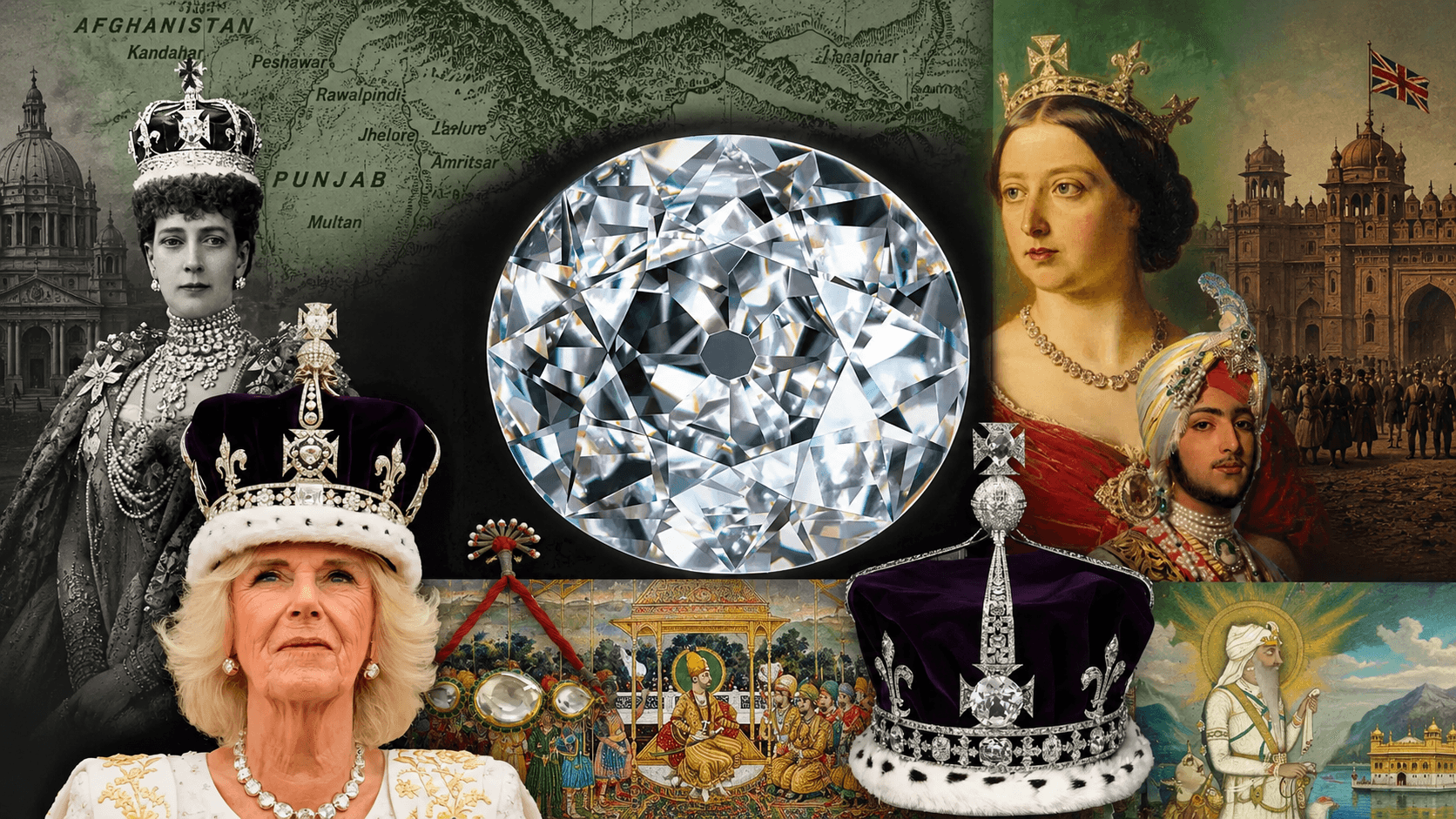
The Story of the Koh-i-Noor
Few diamonds in history have inspired as much fascination, controversy and political debate as the Koh-i-Noor. Today it forms part of the British Crown Jewels, but its journey to London was neither simple nor inevitable. It passed through the hands of emperors, conquerors and kings, becoming more than just a precious gemstone—it became a symbol of power, legitimacy and sovereignty.
The authors, William Dalrymple and Anita Anand, argue that much of the Koh-i-Noor's commonly accepted early history is based on myths that were repeated over generations rather than contemporary evidence. While legends claim the diamond is thousands of years old, its documented history becomes much clearer during the eighteenth century, when it was taken from the Mughal treasury by the Persian ruler Nader Shah after his invasion of Delhi in 1739. From there, the diamond travelled through Persia and Afghanistan before eventually reaching Punjab.
The Arrival of the Koh-i-Noor in Punjab
By 1813, the Koh-i-Noor was in the possession of Shah Shuja Durrani, the former ruler of Afghanistan. Having lost his kingdom during political upheaval, Shah Shuja fled with his family and sought protection from Maharaja Ranjit Singh in Lahore.
Ranjit Singh understood that the Koh-i-Noor was far more than an exceptionally valuable diamond. For generations it had been regarded as a symbol of royal authority. Whoever possessed it carried not only immense wealth but also the prestige associated with the great empires that had ruled before.
The negotiations between the two rulers were anything but straightforward. Shah Shuja refused repeated demands to surrender the diamond, knowing it represented one of the last symbols of his kingship. Instead, he demanded military support, financial assistance and guarantees for the safety of his family before agreeing to part with it. Only after Maharaja Ranjit Singh personally assured him of his friendship did Shah Shuja finally hand over the Koh-i-Noor.
Ranjit Singh's Greatest Symbol of Sovereignty
Although Maharaja Ranjit Singh was known for his relatively simple lifestyle, the Koh-i-Noor occupied a unique place in his court. According to the authors, no previous owner elevated the diamond's importance as much as Ranjit Singh did. He wore it prominently during public ceremonies, transforming it into the defining symbol of the Sikh Empire.
The authors suggest that the diamond meant far more to Ranjit Singh than its monetary value. During his reign, he had reclaimed much of the territory previously controlled by the Afghan Durrani rulers. Possessing the Koh-i-Noor, once the Durrani dynasty's greatest treasure, represented the final confirmation of his victories and reinforced his position as the dominant ruler of the region. It became, in many ways, the jewel that completed the rise of the Sikh Empire.
When the diamond first reached Lahore, however, Ranjit Singh remained cautious. Unsure whether Shah Shuja had attempted to deceive him, he summoned the city's finest jewellers to examine the stone. After careful inspection, they declared it genuine and beyond valuation. The Maharaja then displayed the Koh-i-Noor before his court, where chiefs and nobles gathered to congratulate him on acquiring one of the world's most extraordinary jewels. He later sent Shah Shuja a substantial monetary gift as a gesture of goodwill.
For the next thirty-six years, the Koh-i-Noor remained in Sikh possession and became closely associated with the sovereignty and prestige of the Sikh Empire.
The Fall of the Sikh Empire
The death of Maharaja Ranjit Singh in 1839 marked the beginning of a period of political instability. Court rivalries, assassinations and struggles for power gradually weakened the Sikh Empire. The British East India Company closely monitored these developments and, following two Anglo-Sikh Wars, emerged victorious.
The book describes how the British steadily tightened their control over Punjab. Although the Treaty of Lahore in 1846 promised that the young Maharaja Duleep Singh would continue to rule with British support until he came of age, the reality unfolded very differently. British troops remained stationed in Punjab, British officials gained increasing authority over the administration, and the kingdom gradually lost its independence. The authors describe this process as a slow but deliberate expansion of British control.
The Treaty That Changed Everything
Following the Second Anglo-Sikh War, the Sikh Empire was defeated and Punjab was annexed by the British East India Company.
On 29 March 1849, the ten-year-old Maharaja Duleep Singh was presented with a new Treaty of Lahore. Separated from his mother, surrounded by British officials and with little real choice, he was required to sign away not only his kingdom but also one of its greatest treasures. Among the treaty's terms was a specific clause stating that the Koh-i-Noor, which Maharaja Ranjit Singh had acquired from Shah Shuja, was to be surrendered to the Queen of England.
With that single signature, Punjab ceased to exist as an independent kingdom, and ownership of the Koh-i-Noor formally passed to the British Crown. The authors describe this moment as one of the most significant turning points in the diamond's history—not because it changed the stone itself, but because it symbolised the transfer of power from the Sikh Empire to the British Empire.
A Legacy That Continues Today
More than 175 years later, the Koh-i-Noor remains one of the world's most debated cultural treasures. While it is displayed as part of the British Crown Jewels, its journey continues to spark discussion across South Asia. India, Pakistan, Afghanistan and Iran have all, at different times, laid claim to the diamond, each linking it to a different chapter of its long history.
As Dalrymple and Anand conclude, the Koh-i-Noor's significance lies not in its size or monetary value but in what it represents. It has travelled across empires, survived wars and political upheaval, and become a lasting symbol of conquest, sovereignty and imperial history. Few objects tell the story of South Asia's past as powerfully as the Koh-i-Noor.