
The Forgotten Famine That Changed Punjab Forever
The Chalisa Famine of 1783–1784 was one of the deadliest disasters in Indian history, claiming millions of lives across northern India, including Punjab. Triggered by failed monsoons and severe drought, the famine wiped out crops, emptied villages, and left a lasting mark on the region's history.
By Punjab in a Minute
A disaster that history almost forgot
Imagine waking up one morning to find your village with no food left.
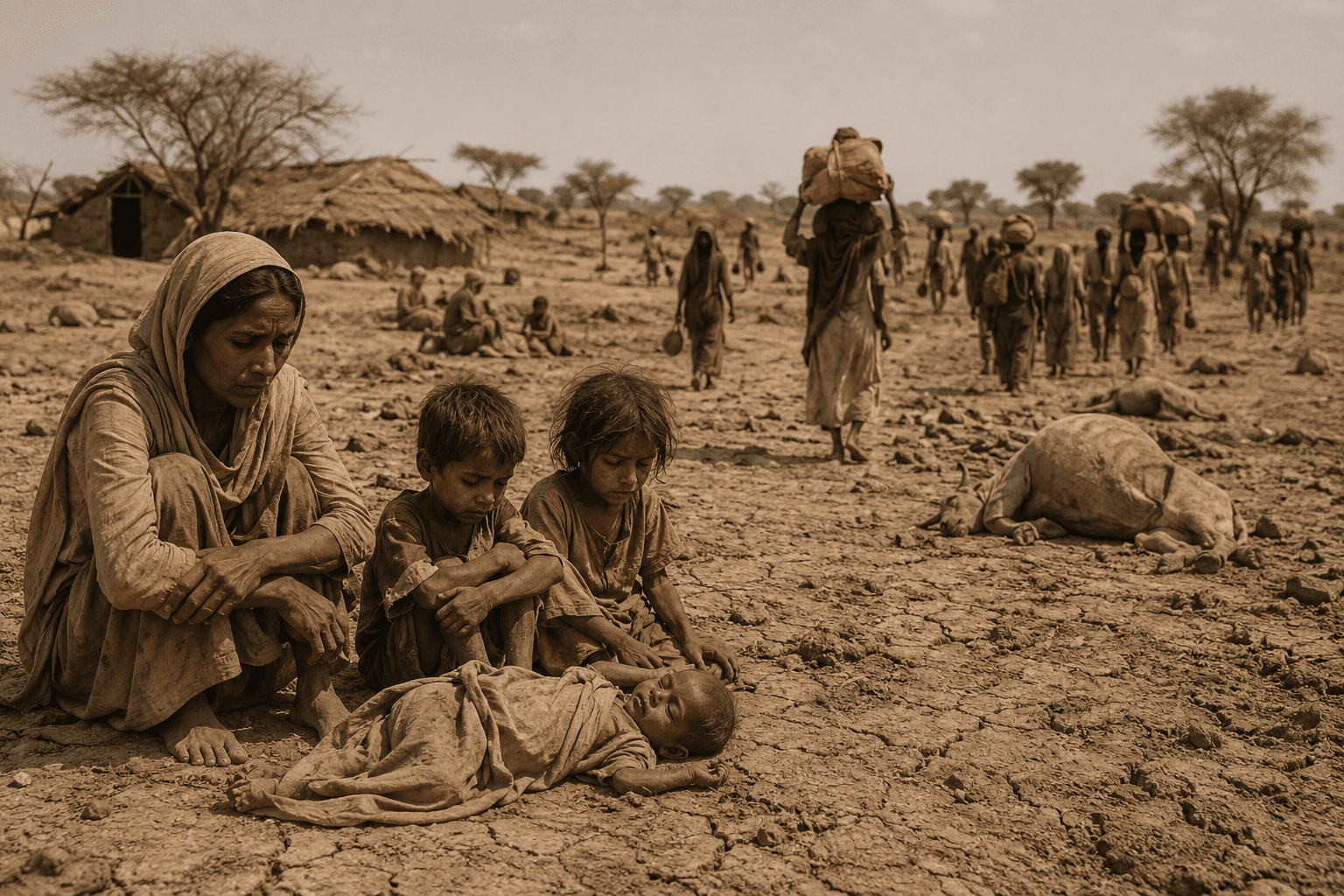
The fields are dry. Wells have stopped producing water. Families are leaving their homes with whatever they can carry, hoping to find food somewhere else. Livestock are dying, grain stores are empty, and disease is beginning to spread.
This wasn't a scene from a movie.
It was the reality across large parts of northern India, including Punjab, during the Chalisa Famine of 1783–1784—one of the deadliest famines in the region's history.
Historians estimate that up to 11 million people may have died during the Chalisa Famine and the famine that preceded it, making it one of the worst humanitarian disasters ever recorded in the Indian subcontinent.
Why was it called the Chalisa Famine?
The famine gets its name from the Vikram Samvat year 1840, commonly known as "Chalisa," which corresponds to 1783 in the Gregorian calendar. Although the name may not be widely recognised today, the suffering it represents left a lasting mark on generations across northern India.
What caused such a devastating famine?
Unlike many historical disasters caused by war, the Chalisa Famine began with nature.
Modern climate research suggests that an unusually strong El Niño disrupted the Indian monsoon for several years. Instead of bringing life-giving rain, the monsoon failed across much of northern India.
Without rain, farmers had little chance of growing crops.
Rice, millet, wheat and barley—all essential food crops—failed one after another. Rivers shrank, wells dried up, and grazing land disappeared. Communities that relied entirely on farming suddenly had nothing left to harvest.
Scientists also believe that the Laki volcanic eruption in Iceland in 1783 may have contributed to unusual global weather patterns, making conditions even worse across parts of the world, including South Asia. While the failed monsoon remained the main cause, these global climate events likely intensified the crisis.
Punjab was not spared
Although the famine affected many parts of northern India, eastern Punjab was among the regions that suffered severe food shortages.
Entire villages struggled to survive as crops failed and livestock died. Families were forced to abandon their homes in search of food and water, while others relied on whatever little grain remained.
At the time, Punjab was not a single united state. Different Sikh Misls controlled different territories, while the Mughal Empire was rapidly losing its authority. This political fragmentation made it difficult to organise a large-scale response across the region.
A land already facing uncertainty
The famine struck during a period of enormous political change.
The once-powerful Mughal Empire had weakened significantly, and many regional rulers were competing for territory and influence.
At the same time, the Sikh Misls were becoming increasingly powerful across Punjab. Frequent conflicts, changing alliances and political instability meant that governments had limited resources to deal with a disaster on this scale.
As food became scarce, prices rose dramatically, making even basic grain unaffordable for many families.
How did people survive?
For many people, survival meant leaving everything behind.
Families walked long distances searching for food. Some migrated to neighbouring regions, while others depended on local rulers, religious institutions and charitable communities for help.
Historical accounts describe abandoned villages, empty farmlands and widespread disease caused by hunger and poor sanitation. Children and the elderly were among the worst affected.
The famine wasn't only killing people through starvation. Diseases such as cholera and dysentery spread quickly among weakened populations, claiming thousands more lives.
Sikh relief efforts
Despite limited resources, some Sikh leaders attempted to provide relief.
Historical records mention Maha Singh of the Sukerchakia Misl, who distributed food and offered shelter to people affected by the famine.
Another important figure was Baghel Singh, who led Sikh forces to Delhi during this period. Following negotiations with the Mughal Emperor, the Sikhs secured the right to collect a share of certain taxes in the city. According to historical accounts, part of these resources was used to help famine-stricken areas in Punjab.
While these efforts helped some communities, they could not fully overcome a disaster that stretched across such a vast region.
The true cost
The Chalisa Famine left scars that lasted long after the rains returned.
Thousands of villages were abandoned.
Agricultural land remained uncultivated for years because there were not enough people left to farm it.
Entire communities disappeared, and migration permanently changed the population of many regions across northern India.
Although historians cannot determine the exact number of deaths, many estimates suggest that around 11 million people may have died during the two consecutive famines of the early 1780s.
Could it happen today?
A famine on this scale is far less likely today.
Modern irrigation systems, better transport networks, weather forecasting and government food reserves mean that drought does not automatically lead to mass starvation.
However, the Chalisa Famine remains a powerful reminder of how closely human life once depended on the arrival of the monsoon—and how climate events can reshape entire societies.
Did You Know?
- The famine is named after the Vikram Samvat year 1840, known as Chalisa.
- It affected present-day Punjab, Delhi, Uttar Pradesh, Rajasthan and Kashmir.
- Scientists link the famine to a prolonged El Niño, with the 1783 Laki volcanic eruption possibly worsening global weather conditions.
- Historians estimate that up to 11 million people may have died during the two famines of the early 1780s.
Why this story matters today
The Chalisa Famine is rarely discussed, yet it remains one of the greatest tragedies to affect Punjab and northern India.
It reminds us how vulnerable societies once were to climate, how fragile food systems could be, and how disasters can shape history for generations.
Remembering stories like these isn't just about looking back—it's about understanding the resilience of the people who lived through them and appreciating the systems that help prevent such tragedies today.
Sources Consulted
This article was prepared using multiple historical references, including climate studies, historical research, demographic analyses, and records relating to the Chalisa Famine of 1783–1784. Key information was cross-referenced from academic and historical sources summarized in the research material you provided.